
Robotic Surgeon in Baner, Pune
Robotic Surgeon in Baner, Pune | Dr. Ammbalal Gurram
Dr. Ammbalal Gurram is a Robotic Surgeon in Baner, Pune, performing robotic-assisted gynecological surgery at Manipal Hospital, Baner. He evaluates each patient’s condition, discusses suitable surgical approaches, and explains the potential benefits, limitations, and alternatives to robotic-assisted procedures as part of treatment planning.
Other Service
Take the First Step to Better Health Today
Consequat vitae dis elit venenatis aliquam id porta duis. Penatibus sem libero sit arcu sem porta et.
Who Is Dr. Ammbalal Gurram, a Robotic Surgeon in Baner, Pune?
Dr. Ammbalal Gurram is a gynecologic surgeon who performs robotic and laparoscopic operations at Manipal Hospital, Baner.
Dr. Ammbalal Gurram holds MBBS, DGO, DNB and MNAMS qualifications. His designation is Head of the Department of Obstetrics and Gynaecology and Senior Consultant, Robotic and Laparoscopic Surgeon at Manipal Hospital, Baner. He completed fellowship training in minimal access surgery. He also consults at Ashwinii Nursing Home in Thergaon, PCMC.
Robotic surgery is a team effort. The operating surgeon, an assistant at the bedside, an anaesthetist and theatre nurses each handle a defined part of the operation. Robotic surgery in Baner, Pune, therefore depends on the hospital team and not on one person.
What is gynae robotic surgery, and how does it work?
Lorem ipsum dolor sit amet, consectetur adipiscing elit. Ut elit tellus, luctus nec ullamcorper mattis, pulvinar dapibus leo.
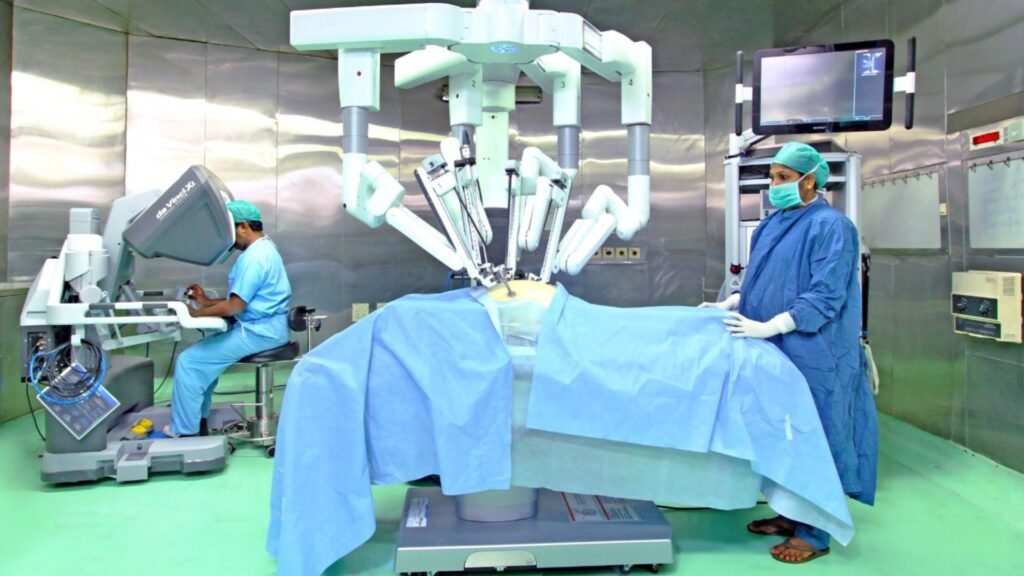
Gynae robotic surgery is keyhole surgery in which the surgeon controls the instruments from a console. The robot does not operate on its own.
The surgeon sits at a console in the operating theatre and sees a magnified three-dimensional view of the pelvis. Hand controls move the instrument arms. The system copies each movement and filters out hand tremor.
The instruments enter through a few small cuts, typically 5 to 12 millimetres long. Their wristed tips bend and rotate, which the rigid instruments of standard laparoscopy cannot do. Whether that matters depends on the operation and the patient. Gas inflates the abdomen to create a working room, and you lie tilted head down during pelvic work.
The US Food and Drug Administration cleared robotic systems for gynecologic surgery in 2005.
How Does Robotic Surgery Compare With Laparoscopic and Open Surgery?
For many benign conditions, robotic surgery gives results similar to standard laparoscopy at a higher cost. Its role is mainly in complex cases.
A fair comparison starts with the limits of the technique.
Limited evidence.
The American College of Obstetricians and Gynecologists (ACOG) describes the quality of data on robot-assisted gynecologic surgery as low to moderate.
Similar outcomes in many cases.
A pooled analysis of randomised trials compared robotic and standard laparoscopic hysterectomy for benign disease. It found no clear difference in blood loss, hospital stay, operating time or conversion to open surgery.
Higher cost.
The equipment, disposable instruments and theatre set-up add to the hospital bill.
No sense of touch.
The console does not pass the feel of tissue to the surgeon’s hands, so the surgeon relies on vision and training.
Set-up time.
The team must position the robot and attach it to the patient before the operation starts.
Robotic assistance still has a place. ACOG notes that it can improve visualisation and ergonomics, especially in patients with a higher body mass index. Compared with open abdominal surgery, any minimally invasive approach gives a faster return to normal activity, a shorter stay and better quality of life. For hysterectomy, ACOG still prefers the vaginal route whenever it is feasible.
The choice of route rests on your diagnosis, anatomy and previous surgery. Robotic surgery in Pune suits some patients and not others.
Which Conditions Can a Robotic surgeon in Baner, Pune Treat?
Surgeons consider the robotic route when the pelvis is crowded, scarred or hard to reach.
Uterine fibroids
Robotic myomectomy removes fibroids and keeps the uterus. Multiple or deeply embedded fibroids need careful suturing of the uterine wall.
Endometriosis
Deep disease on the bowel, bladder or pelvic ligaments needs careful excision. The three-dimensional view helps the surgeon separate scar tissue from healthy organs.
Adenomyosis
When adenomyosis is focal, laparoscopic adenomyomectomy removes the affected area and preserves the uterus. A robotic route is an option in selected patients.
Ovarian cysts
Cystectomy removes the cyst and keeps healthy ovarian tissue, which matters in endometriomas.
Hysterectomy in complex cases
A large uterus, dense adhesions from earlier caesarean sections and coexisting endometriosis can make standard routes difficult. Simple cases often suit a vaginal hysterectomy.
Pelvic organ prolapse
Operations such as hysteropexy surgery and pectopexy surgery lift the uterus or vaginal vault back into position. Surgeons can perform them through the robotic route in suitable patients.
When Is Robotic Surgery Not the Right Choice?
Robotic surgery is not always needed, and some conditions call for another approach. A surgeon may advise against robotic surgery in Baner, Pune in these situations:
1 — A simple case with a clear vaginal route.
Vaginal hysterectomy avoids abdominal incisions, and ACOG prefers it when feasible.
2 — Early cervical cancer needing radical hysterectomy.
The LACC randomised trial compared minimally invasive radical hysterectomy, laparoscopic or robotic, with open surgery. Women in the minimally invasive group were more likely to see the cancer return and less likely to be alive at three years. The oncology team chooses the route for radical hysterectomy using current guidance.
3 — Conditions that rule out a steep head-down position.
Severe heart or lung disease, certain eye conditions and raised pressure inside the skull can make the position or the gas unsafe. The anaesthetist makes this call.
4 — A large pelvic mass that may be cancerous.
The plan must avoid spilling its contents, and open surgery is often the safer route.
5 — Little added benefit for the extra cost.
If laparoscopy gives the same result for your diagnosis, the lower-cost route is reasonable.
What Are the Risks of Robotic Surgery?
Robotic surgery in Baner, Pune carries the same core risks as other pelvic surgery, and the surgeon explains them before you consent.
- Bleeding, which occasionally needs a blood transfusion
- Infection of the wound, urinary tract or pelvis
- Injury to the bladder, ureter, bowel or blood vessels
- Reactions to anaesthesia
- Blood clots in the leg veins
- Shoulder-tip pain from the gas, which usually settles within a few days
- Pressure effects on nerves or skin from positioning
- Hernia at an incision site
- Conversion to laparoscopic or open surgery when the operation cannot continue safely
Conversion is a safety decision, not a failure. The chance of each risk depends on the operation, your general health and any previous surgery. A robotic surgeon in Baner, Pune explains these risks for your case before you sign the consent form.
How Does a Robotic Surgeon in Baner, Pune Choose the Surgical Approach?
The approach follows your diagnosis and anatomy, not the technology on offer.
- History and examination- Symptoms, previous surgeries, childbirth history and a pelvic examination.
- Imaging-Pelvic ultrasound first, with MRI when the surgeon suspects deep endometriosis or adenomyosis.
- Blood tests and screening- Haemoglobin and routine tests, plus a Pap smear or HPV test if due.
- Anaesthesia fitness- Heart, lung and other conditions that affect the head-down position.
- Options discussion- Medicines, vaginal, laparoscopic, robotic and open surgery, with the benefits, risks and costs of each.
ACOG states that informed consent should cover the surgeon’s own robotic experience. It should also compare the risks and benefits with other approaches .
What Happens Before, During and After Robotic Surgery in Baner, Pune?
Hospital stay and recovery vary with the operation. The timelines below are general estimates, not promises.
- Before surgery- You receive fasting instructions and a review of your medicines. Some endometriosis cases need bowel preparation.
- During surgery- The operation takes place under general anaesthesia. Duration depends on the procedure, since deep endometriosis excision takes longer than a simple hysterectomy.
- First day- The team usually encourages walking on the first day. Pain relief and clot-prevention measures continue as advised.
- Hospital stay. Often one to two days for uncomplicated cases (industry estimate).
- Return to routine- Light desk work is often possible within one to two weeks (industry estimate). Heavy lifting, sport and long travel wait longer, as the surgeon advises.
- Follow-up- A review visit checks the wounds and covers the histopathology report when the surgeon removes tissue.
Recovery after robotic surgery in Baner, Pune, varies with the procedure, your health and any complication. Your surgeon’s instructions take priority over any general timeline.
What Does Robotic Surgery in Baner, Pune Cost?
Robotic surgery usually costs more than standard laparoscopy, and the final bill depends on the procedure, hospital category and length of stay.
- The operation- A myomectomy, a hysterectomy and an endometriosis excision carry different theatre and instrument costs.
- Disposable robotic instruments- These add a fixed charge to each case.
- Room category and stay-A longer stay or a higher room category raises the total.
- Investigations and consumables- Scans, blood tests, implants such as mesh and medicines form part of the estimate.
- Complications- An unplanned conversion or a longer stay changes the final figure.
Insurance policies differ in how they treat robotic surgery. Ask the hospital’s insurance desk to confirm cover, room-rent limits and pre-authorisation before admission. Ask for a written estimate after the consultation.
Why Does Follow-Up Care Matter After Robotic Surgery?
Follow-up visits check healing and review the pathology report. Some symptoms need urgent attention at any time.
- Fever or chills
- Heavy vaginal bleeding
- Pain that is getting worse
- Persistent vomiting
- Swelling or pain in one leg
- Breathlessness or chest pain
Where Does Dr. Ammbalal Gurram Perform Robotic Surgery in Baner?
Dr. Ammbalal Gurram performs robotic gynecologic surgery at Manipal Hospital, Baner, Pune.
- Manipal Hospital, Baner: Survey No 111/11/1, Veerbhadra Nagar Road, Baner-Mahalunge Road, Baner, Pune
- Ashwinii Nursing Home, Thergaon: 1st Floor, Samarth Carina, Ganga Aashiyana Road, behind Kamal Diagnocare, Thergaon, Pimpri-Chinchwad, Pune
The hospital lists gynaecology among its robotic surgery specialties [7]. The contact page lists contact details. You can read more about Dr. Ammbalal Gurram and see other services under gynecology treatments.
Frequently Asked Questions About Robotic Surgery in Baner, Pune
Who is a robotic surgeon in Baner, Pune for gynecologic conditions?
Dr. Ammbalal Gurram is a gynecologic surgeon who performs robotic and laparoscopic surgery at Manipal Hospital, Baner. He is Head of the Department of Obstetrics and Gynaecology there and holds MBBS, DGO, DNB and MNAMS qualifications.
Does a robot perform the surgery on its own?
No. The surgeon controls every movement from a console. The system copies hand movements and filters tremor, but it cannot act without the surgeon's input.
Is robotic surgery safe?
Robotic-assisted surgery is an established approach in gynecology. Risk still depends on case selection, surgeon training and the hospital team. Bleeding, infection and organ injury can occur, and the surgeon explains them before consent.
Is robotic surgery better than laparoscopy?
Not always. For many benign conditions, trials show similar results at a higher cost. A robotic surgeon in Baner, Pune, may consider robotic assistance in complex cases such as deep endometriosis, large fibroids or dense adhesions.
How long does recovery take after robotic hysterectomy?
After robotic surgery in Baner, Pune, many people go home in one to two days. They often return to light routine work in one to two weeks (industry estimate). Full recovery, including lifting and exercise, takes longer. Your surgeon sets the timeline for your case.
Does robotic surgery leave scars?
The incisions are small, typically 5 to 12 millimetres, and most fade over time. If the surgeon must convert to open surgery for safety, the scar is larger.
Is robotic surgery more expensive than laparoscopy?
Yes, robotic surgery in Baner, Pune, usually costs more because of the equipment and disposable instruments. The final figure depends on the procedure, hospital category and length of stay. Ask for a written estimate and check your insurance cover.
Can a surgeon remove fibroids robotically without removing the uterus?
Yes. Robotic myomectomy removes fibroids and keeps the uterus. Suitability depends on the number, size and position of the fibroids, which a scan shows.
Is robotic surgery used for endometriosis?
Surgeons can use it for deep endometriosis that involves the bowel, bladder or pelvic ligaments. Imaging and symptoms decide whether you need surgery and which route suits you.
How do I know whether I need robotic surgery or laparoscopy?
Your diagnosis, scan findings, body weight and earlier surgeries decide the route. A robotic surgeon in Baner, Pune, explains why one approach suits you better than another and lists the alternatives.