
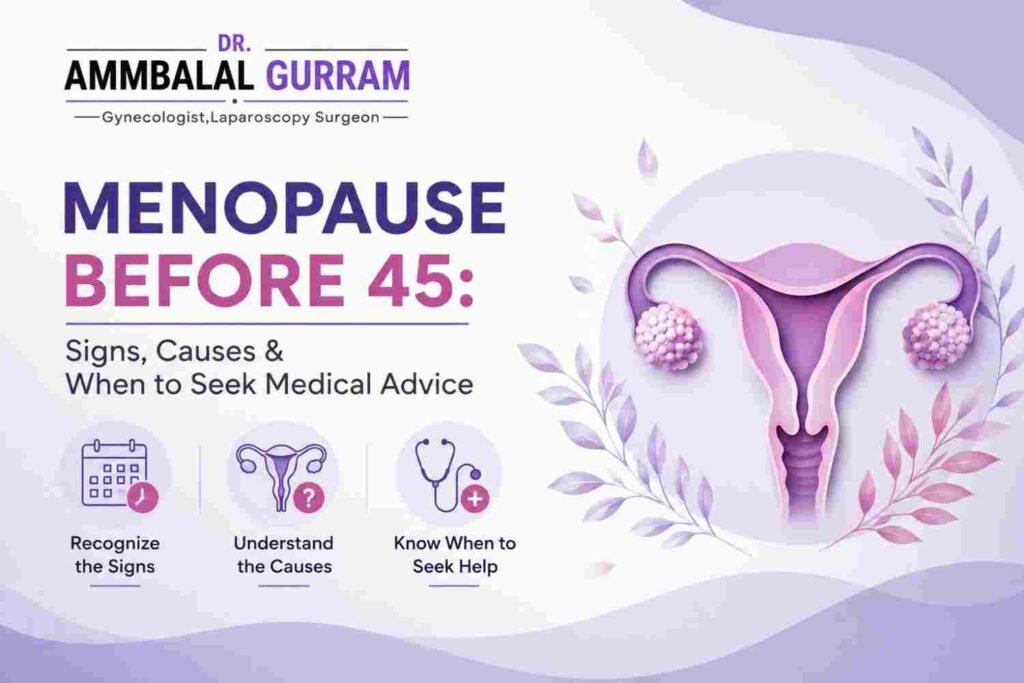
| Menopause reaching before age 45 is called early menopause, and before age 40 it’s called premature menopause (or premature ovarian insufficiency). It happens when the ovaries stop releasing eggs and producing oestrogen ahead of the typical age range of 45–55. Common signs include irregular or missed periods, hot flushes, night sweats, vaginal dryness, mood changes, and difficulty sleeping. Because it raises longer-term risks for bone and heart health, it’s worth getting evaluated by a gynaecologist rather than waiting it out. |
Most women expect menopause to arrive somewhere in their late 40s or early 50s. So when periods start becoming irregular — or stop altogether — at 38, or 42, or 44, the first reaction is usually confusion rather than concern. Is this really menopause? Isn’t that too early?
It’s a fair question, and one worth taking seriously rather than dismissing as just stress or just getting older. Menopause before 45 has identifiable causes in many cases, and it carries health implications that go beyond fertility. Here’s what actually defines it, what to watch for, and when it’s time to have it checked rather than wait it out.
What Counts as Early Menopause?
Natural menopause is diagnosed after 12 consecutive months without a period, and it typically happens between ages 45 and 55, with 51 being a commonly cited average. When it happens before that window, doctors use two more specific terms:
- Early menopause — menopause occurring between ages 40 and 45.
- Premature menopause / Premature Ovarian Insufficiency (POI) — menopause or ovarian function loss occurring before age 40.
The distinction matters clinically. POI in particular is treated differently from natural menopause because it happens so far ahead of the expected timeline that it often points to an underlying cause worth investigating — and because the extended years of low oestrogen exposure that follow carry their own risks.
It’s also worth separating this from perimenopause, the transitional phase of irregular cycles and fluctuating hormones that can begin years before periods stop completely. Perimenopause starting in the late 30s or early 40s is not unusual on its own; what matters is how it’s progressing and whether periods stop altogether well ahead of schedule.
Signs of Menopause Before 45
The symptoms of early or premature menopause are largely the same as those of menopause at any age — the difference is the age at which they show up. Common signs include:
- Irregular periods — cycles that become shorter, longer, lighter, heavier, or unpredictable
- Missed periods for three months or more without pregnancy
- Hot flushes and night sweats
- Vaginal dryness or discomfort during intercourse
- Sleep disturbance, independent of night sweats
- Mood changes — irritability, low mood, or anxiety that feels different from your usual pattern
- Reduced libido
- Difficulty concentrating or brain fog
- Fatigue that doesn’t track with sleep or activity levels
- Dry skin, thinning hair, or joint aches
No single symptom confirms menopause on its own — many of these overlap with thyroid conditions, stress, anaemia, or other hormonal shifts. That overlap is exactly why a change in periods before 45, especially alongside two or more of the symptoms above, is worth a clinical evaluation rather than a guess.
What Causes Menopause Before 45?
In a substantial number of premature and early menopause cases, no clear cause is ever identified — this is described as idiopathic. But several recognised causes and risk factors account for the rest:
Surgical causes
- Bilateral oophorectomy — surgical removal of both ovaries, which causes immediate (surgical) menopause regardless of age
- Hysterectomy that preserves the ovaries can still bring menopause forward by disrupting ovarian blood supply, even though periods stop for a different reason
Medical treatments
- Chemotherapy or pelvic radiotherapy, which can damage ovarian tissue
- Certain long-term medications affecting ovarian function
Genetic and autoimmune factors
- Family history — a mother or sister who went through early menopause raises individual risk
- Chromosomal conditions such as Turner syndrome or Fragile X premutation
- Autoimmune disorders, where the immune system affects ovarian tissue (sometimes alongside autoimmune thyroid or adrenal conditions)
Lifestyle-associated factors
- Smoking is consistently linked to earlier menopause onset
- Certain metabolic and nutritional factors, though these play a smaller and less predictable role than genetics or medical history
Identifying the cause isn’t just academic. It shapes the conversation around fertility (if relevant), the choice and duration of hormone therapy, and whether other family members or first-degree relatives should be aware of a genetic pattern.
Why Early Menopause Needs Attention, Not Just Acceptance
Oestrogen does more than regulate the menstrual cycle — it has a protective role in bone density, cardiovascular health, and vaginal and urinary tissue. When menopause arrives well before the typical age, the body spends more years without that protective effect. This is linked to:
- Higher long-term risk of osteoporosis and fracture
- Increased cardiovascular risk over time
- More persistent vaginal and urinary symptoms if left unmanaged
- For premature menopause specifically, loss of natural fertility earlier than expected, which matters for women who haven’t completed their families
None of this is meant to alarm — it’s the reason early and premature menopause are managed proactively, usually with hormone therapy considered up to the natural average age of menopause, rather than simply monitored.
How It’s Diagnosed
Diagnosis starts with a detailed history — menstrual pattern, symptom timeline, family history, and any past surgery, chemotherapy, or autoimmune conditions — followed by blood tests. The key markers are:
- FSH (Follicle-Stimulating Hormone) — persistently elevated FSH on repeat testing is a core indicator of declining ovarian function
- Estradiol — typically low when ovarian function has declined
- AMH (Anti-Müllerian Hormone) — reflects ovarian reserve and is useful when fertility planning is part of the conversation
- Thyroid function and prolactin — to rule out other causes of irregular or absent periods
Because hormone levels can fluctuate, especially during perimenopause, a diagnosis of early or premature menopause is usually confirmed with repeat testing over time rather than a single blood draw.
When to See a Gynaecologist
It’s worth booking a consultation — rather than waiting to see what happens over the next few cycles — if any of the following apply:
- Periods have stopped for three months or more before age 45, and pregnancy is ruled out
- Periods have become significantly irregular for several months in a row
- Hot flushes, night sweats, or vaginal dryness appear well before age 45
- There’s a family history of early or premature menopause
- Menopausal symptoms appear after chemotherapy, radiotherapy, or ovarian/uterine surgery
- Fertility is a current concern and cycles have become unpredictable
An early evaluation doesn’t commit anyone to a particular treatment — it simply confirms what’s happening and opens up the options while they’re most effective, whether that’s hormone therapy, bone health monitoring, or fertility discussions.
How Early Menopause Is Managed
Management is individualised based on age, symptoms, cause, and personal and family medical history. Broadly, it can include:
- Hormone Replacement Therapy (HRT) — often recommended at least until the natural average age of menopause, to protect bone and cardiovascular health, unless there’s a specific reason it isn’t suitable
- Non-hormonal options for symptom relief where HRT isn’t appropriate or preferred
- Bone density monitoring, given the extended low-oestrogen window
- Cardiovascular risk assessment as part of routine follow-up
- Fertility counselling where family planning is still relevant
- Support for vaginal and urinary symptoms, which are common but under-discussed
None of this is one-size-fits-all, which is exactly why it’s a conversation to have in person rather than a protocol to follow from a general article.
Gynaecological Care in Baner & Thergaon, Pune
Dr. Ammbalal Gurram sees patients with menstrual irregularities and menopause-related concerns across the Baner and Thergaon clinics in Pune. For women noticing period changes well ahead of their late 40s, an in-person evaluation — history, examination, and the relevant blood work — gives a far clearer picture than symptom-checking alone, and it’s the starting point for any treatment decision that follows.
Common Questions
1. Can you go through menopause at 42?
Yes. Menopause between ages 40 and 45 is classified as early menopause and isn’t rare — it has recognised causes ranging from genetics to prior surgery, though in many cases no single cause is found.
2. Is menopause at 40 considered premature?
Menopause before age 40 is classified as premature menopause or premature ovarian insufficiency (POI), and it’s generally evaluated more closely because of the extended years of low oestrogen exposure that follow.
3. What is the youngest age you can start menopause?
Premature ovarian insufficiency can occur in the teens or twenties in rare cases, most often linked to genetic, autoimmune, or medical treatment-related causes, though this is uncommon.
4. Can early menopause be reversed?
Natural ovarian function that has declined generally does not reverse on its own. Management instead focuses on hormone therapy and symptom control, and — where relevant — fertility options are discussed separately with a specialist.
Dr. Ammbalal Gurram best Recognised Gynecologist In Pune
Dr. Ammbalal Gurram is a gynaecologist and laparoscopic surgeon seeing patients at clinics in Baner at Manipal hospital and Thergaon at Ashwinii Nursing Home, Pune, with a practice that includes menstrual disorders, menopause management, and gynaecological surgery.
Frequently Asked Questions
Q: What’s the difference between perimenopause and early menopause?
Perimenopause is the transition phase with irregular cycles and fluctuating hormones, which can start years before periods stop. Early menopause specifically refers to periods stopping completely before age 45.
Q: Does early menopause affect fertility permanently?
For most women, yes — once ovarian function has declined significantly, natural conception becomes unlikely. Women who want to preserve fertility options, especially after a POI diagnosis, should raise this early with their gynaecologist rather than after the fact.
Q: Are there blood tests to confirm early menopause?
Yes — FSH, estradiol, and often AMH and thyroid function are checked, generally with repeat testing to confirm a consistent pattern rather than relying on one blood draw.
Q: Is HRT safe if menopause starts early?
HRT is commonly recommended for early and premature menopause specifically because of the extended low-oestrogen period involved, but suitability depends on individual health history and should be assessed directly with a gynaecologist.
Q: Can stress cause missed periods that look like early menopause?
Yes — stress, significant weight changes, thyroid issues, and other conditions can all cause missed or irregular periods that mimic early menopause. That overlap is exactly why blood testing, not symptoms alone, is used to confirm a diagnosis.