
Table of Contents
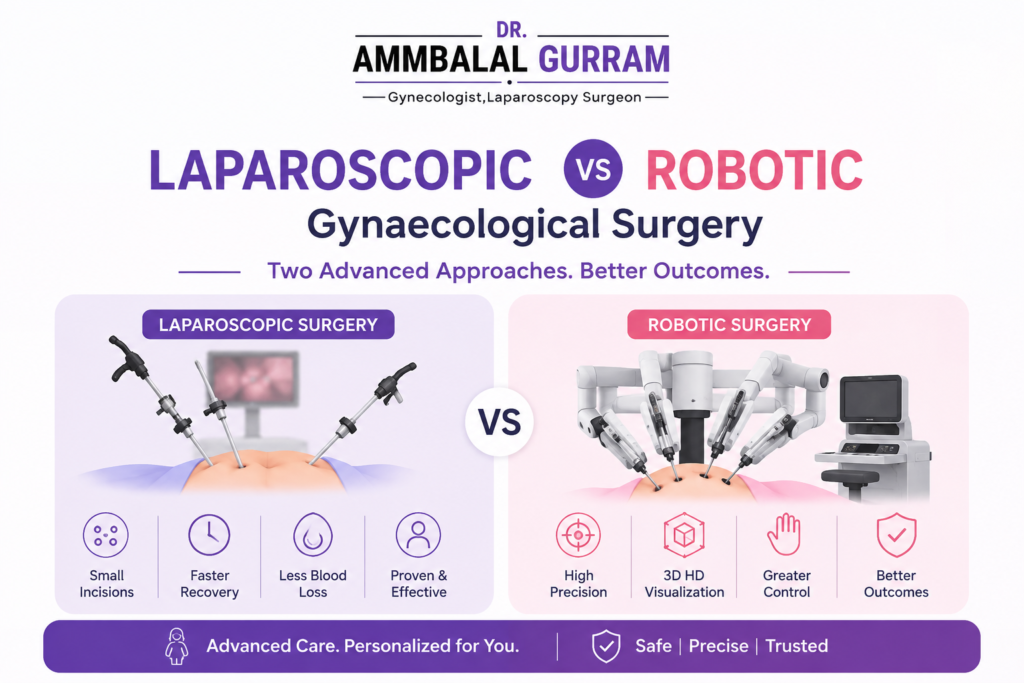
Women exploring minimally invasive treatment for fibroids, endometriosis, ovarian cysts, or hysterectomy often come across two options: laparoscopic surgery and robotic surgery. Both avoid the large incisions of traditional open surgery, but they are not the same procedure. Understanding laparoscopic vs robotic gynaecological surgery helps patients ask the right questions before choosing a treatment path.
This blog compares both techniques across technique, precision, recovery, cost, and which conditions each is best suited for.
What Is Laparoscopic Surgery?
Laparoscopic surgery is a minimally invasive technique where the surgeon operates through small incisions, usually 0.5 to 1 centimetre each, using a thin camera called a laparoscope and long, handheld surgical instruments. The surgeon views the surgical area on a monitor and controls the instruments directly with their hands.
Laparoscopy has been used in gynaecology for decades and is considered the standard minimally invasive approach for many procedures, including hysterectomy, myomectomy, ovarian cystectomy, and tubal surgery.
What Is Robotic Surgery?
Robotic surgery is also minimally invasive and uses small incisions similar to laparoscopy. The key difference is how the surgeon controls the instruments. Instead of holding the instruments directly, the surgeon sits at a console a few feet away and controls robotic arms that hold the camera and instruments inside the patient’s body.
The robotic system translates the surgeon’s hand movements into precise, scaled-down movements inside the body, and often filters out natural hand tremor. The surgeon still makes every decision and movement; the robot does not operate independently.
Laparoscopic vs Robotic Gynaecological Surgery: Core Differences
Here is how the two techniques compare across the factors that matter most to patients:
| Factor | Laparoscopic Surgery | Robotic Surgery |
|---|---|---|
| Instrument Control | Surgeon holds and moves instruments directly by hand | Surgeon controls robotic arms from a console; movements are translated by the system |
| Visualization | Standard 2D, or 3D in some setups | High-definition 3D with greater magnification |
| Range of Motion | Straight-line movement, limited wrist-like motion | Wider range of motion, closer to a human wrist, useful in tight spaces |
| Precision and Tremor Filtering | Depends entirely on the surgeon’s hand steadiness | Filters out natural hand tremor and scales down large movements |
| Surgeon Position | Stands beside the patient | Sits at a console, which can reduce physical strain in long procedures |
| Setup Time and Cost | Quicker setup, lower cost | Higher equipment cost, usually reflected in procedure cost |
| Learning Curve | Well-established training pathway | Requires additional specialized training on the robotic system |
Which Conditions Are Treated With Each Technique?
Both laparoscopic and robotic approaches treat similar gynaecological conditions, though the choice often depends on complexity and surgeon experience:
| Condition | Typical Approach | Notes |
|---|---|---|
| Hysterectomy | Both techniques commonly used | Robotic may be preferred for larger uteri or complex anatomy |
| Myomectomy (Fibroid Removal) | Both work well | Robotic assistance can help with precise suturing in multiple fibroid cases |
| Endometriosis Excision | Both used | Robotic’s enhanced visualization can help with deeply infiltrating disease; experienced laparoscopic surgeons achieve strong results too |
| Ovarian Cystectomy | Laparoscopy typically sufficient | Straightforward cases handled well without robotic assistance |
| Tubal Surgery and Adhesiolysis | Laparoscopy is standard | Includes treatment for blocked fallopian tubes |
| Sacrocolpopexy (Pelvic Organ Prolapse Repair) | Robotic often preferred | Precise suturing in confined pelvic space benefits from added dexterity |
Does Robotic Surgery Give Better Results Than Laparoscopy?
This is one of the most common questions patients ask, and the honest answer is that outcomes depend more on the surgeon’s experience than on the technology itself. Several points are worth understanding:
- For most standard gynaecological procedures, laparoscopic and robotic surgery produce similar outcomes in terms of complication rates, blood loss, and hospital stay.
- Robotic surgery can offer an advantage in complex cases involving deep pelvic anatomy, extensive scar tissue, or procedures requiring intricate suturing.
- An experienced laparoscopic surgeon often achieves outcomes equal to robotic surgery for routine procedures, since surgical skill matters more than the tool used to perform it.
- Robotic systems do not replace surgical judgment. The surgeon still makes every decision about how to proceed during the operation.
Choosing between the two often comes down to the specific condition, the surgeon’s expertise with each technique, and practical factors like cost and hospital availability.
Recovery: Laparoscopic vs Robotic Surgery
Recovery timelines are broadly similar between the two techniques, since both involve small incisions rather than a large abdominal cut:
| Recovery Factor | Laparoscopic Surgery | Robotic Surgery |
|---|---|---|
| Hospital Stay | 1 to 2 days | 1 to 2 days |
| Return to Light Activity | Within a week | Within a week |
| Full Recovery | 2 to 4 weeks | 2 to 4 weeks |
| Pain Levels | Significantly less than open surgery | Significantly less than open surgery, no major difference vs laparoscopy |
| Comparison to Open Surgery | 3 to 5 days hospital stay for open surgery | 3 to 5 days hospital stay for open surgery |
Patients should not expect meaningfully faster recovery from robotic surgery compared to laparoscopy for the same procedure. The recovery advantage of both techniques comes from avoiding open surgery, not from choosing one minimally invasive method over the other.
Cost Differences
Robotic surgery generally costs more than laparoscopic surgery. The higher cost comes from the equipment itself, specialized instrument costs, and the additional operating time robotic setup can require. For patients weighing the two options, cost is often the deciding factor when both techniques are expected to give similar outcomes for their specific condition.
Insurance and hospital package coverage can also vary between the two, so patients should confirm costs directly with the hospital and check what their coverage includes before deciding.
Which One Should You Choose?
There is no universal answer, since the right choice depends on the individual case. This quick reference helps:
| Situation | Suggested Approach |
|---|---|
| Routine ovarian cystectomy or tubal surgery | Laparoscopy — usually sufficient and more cost-effective |
| Deep endometriosis, large fibroids, or pelvic floor repair | Robotic assistance may help, especially with an experienced robotic surgeon |
| Surgeon highly experienced in laparoscopy, less so in robotics | Laparoscopy — outcomes often equal robotic surgery in skilled hands |
| Cost is a primary concern | Laparoscopy — generally the lower-cost option |
| Complex anatomy requiring precise suturing in a confined space | Robotic surgery — added dexterity can help |
The surgeon’s experience with the chosen technique matters more than the technology itself. Discuss your specific diagnosis, complexity, and cost considerations directly with your gynaecologist before deciding.
Frequently Asked Questions
Is robotic surgery safer than laparoscopic surgery? Both are considered safe, well-established approaches. Complication rates are broadly similar for most gynaecological procedures, and safety depends more on the surgeon’s experience than the technique used.
Does robotic surgery hurt less than laparoscopy? No significant difference in pain levels has been shown between the two. Both cause far less pain than open surgery due to smaller incisions.
Is robotic surgery always better for hysterectomy? Not always. Robotic assistance can help with complex or large uterus cases, but standard laparoscopic hysterectomy remains effective and appropriate for most patients.
Why does robotic surgery cost more? The cost difference comes from the robotic system itself, specialized instruments, and setup requirements, which are reflected in the overall procedure cost.
Can all gynaecological surgeries be done robotically? Most minimally invasive gynaecological procedures can be performed either way, but availability depends on the hospital’s equipment and the surgeon’s training on the robotic system.
How do I know which option is right for my case? Your gynaecologist will assess your specific condition, its complexity, and your overall health before recommending laparoscopic or robotic surgery. A direct consultation is the best way to get a personalized recommendation.
Consult a Laparoscopic Surgeon for Your Gynaecological Condition
Choosing between laparoscopic and robotic surgery works best with a proper evaluation of your specific condition and its complexity.
Dr. Ammbalal Gurram Gynaecologist & Laparoscopic Surgeon 22 years of experience in gynaecological and laparoscopic care
- Qualifications: MBBS, DGO, DNB, MNAMS, FMAS, FICMCH, FICOG, FIAGE, FICS (USA)
- Memberships: IMA, POGS, FOGSI, IAGE, ICOG, ICS
- Registration No.: 2000/01/0082
- Mobile: +91-86007 11131