
Endometriosis: Why oes Period Pain Sometimes Become Severe?
Most women experience some discomfort during their periods. For many, painful menstruation is mild and settles with rest, a hot water bag or a simple painkiller. But for some women, the pain is entirely different. Severe menstrual cramps can make it impossible to attend work or college, medicines stop helping, and the pain seems to get worse with every cycle.
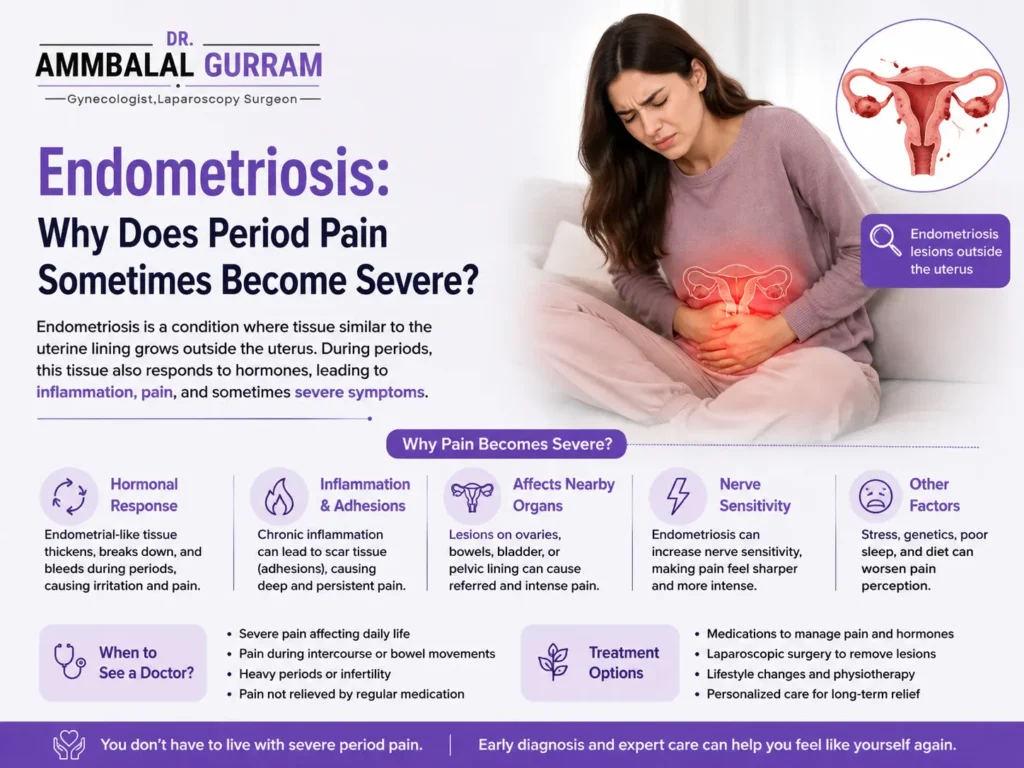
If this sounds familiar, you should know that extremely severe period pain is not something you simply have to put up with. It can be a sign of endometriosis, a common but often undiagnosed condition. In this blog, we explain what endometriosis is, why period pain becomes severe, the symptoms and early warning signs to watch for, how endometriosis is diagnosed, and the treatment options available, including endometriosis surgery.
What Is Endometriosis?
Every month, the lining of the uterus, called the endometrium, thickens to prepare for a possible pregnancy. If pregnancy does not happen, this lining sheds as menstrual bleeding.
In endometriosis, tissue similar to this lining grows outside the uterus. It is most often found on the ovaries, fallopian tubes, the pelvic wall, and the surface of the bowel or bladder. This misplaced tissue still responds to the monthly hormonal cycle. It thickens, breaks down and bleeds, but the blood has no way to leave the body. That is the starting point for pain, inflammation and many of the complications of the condition.
Causes of Endometriosis
The exact cause of endometriosis is still not fully understood. Doctors believe that several factors may play a role in the causes of endometriosis:
- Retrograde menstruation: during a period, some menstrual blood may flow backwards through the fallopian tubes into the pelvis, carrying endometrial cells with it. These cells may then attach and grow.
- Hormonal influence: estrogen drives the growth of endometriosis tissue, which is why symptoms often follow the menstrual cycle.
- Immune system factors: in some women, the immune system may not clear misplaced endometrial cells effectively.
- Genetics: endometriosis is more common in women who have a close relative with the condition.
- Cell changes and surgical scars: some theories suggest that certain cells can transform into endometrial-like tissue, or that cells may be carried to surgical scars after pelvic surgery such as a C-section.
Having one of these factors does not mean a woman will definitely develop endometriosis, and many women with no obvious risk factors are affected as well.
Why Does Period Pain Become Severe in Endometriosis?
Many women ask, “Why are periods extremely painful for me when other women seem to cope?” In endometriosis, there is usually more than one reason behind severe pain.
1. Bleeding with nowhere to go
Endometriosis tissue bleeds each month. Unlike normal menstrual blood, this blood stays trapped inside the pelvis and irritates the surrounding tissue.
2. Chronic inflammation
The trapped blood and tissue trigger inflammation. Inflammatory chemicals such as prostaglandins heighten pain and make the uterus contract more strongly, causing severe period cramps.
3. Adhesions and scar tissue
Repeated inflammation can form bands of scar tissue that bind pelvic organs together. When these organs move or the uterus contracts, the adhesions pull on them and cause sharp or dragging pain.
4. Endometriomas (chocolate cysts)
Endometriosis on the ovary can create cysts filled with old blood. These may cause persistent pelvic pain and can affect fertility.
5. Nerve involvement and pain sensitisation
Endometriosis deposits can grow close to pelvic nerves. Over time, the nervous system can become more sensitive to pain signals, so the pain feels stronger and may continue even outside the period.
6. Deep infiltrating endometriosis
When the disease grows deeper into tissues such as the area behind the uterus, the bowel or the bladder, the pain is often more intense and may come with bowel or urinary symptoms.
7. Coexisting adenomyosis
Some women also have adenomyosis, where similar tissue grows within the muscular wall of the uterus. Together, the two conditions can lead to heavy bleeding and very painful periods.
Other Causes of Painful Periods
Not every case of painful menstruation is endometriosis. Other causes of painful periods include:
- Primary dysmenorrhea, which is common cramping caused by natural uterine contractions
- Uterine fibroids
- Adenomyosis
- Pelvic inflammatory disease (a pelvic infection)
- Ovarian cysts
- Cervical stenosis or other structural problems
Because several conditions can look similar, a proper medical evaluation is the only reliable way to find the cause.
Difference Between Normal Period Pain and Endometriosis
It can be hard to tell whether your pain is within the normal range. This comparison highlights the key differences:
| Feature | Normal Period Pain | Endometriosis Pain |
| Intensity | Mild to moderate cramps | Severe menstrual cramps, often extremely severe period pain |
| Response to painkillers | Usually relieved | Often partly relieved or not relieved at all |
| Timing | Starts with or just before bleeding, eases in 1 to 3 days | May begin days before the period and continue after it, or occur between periods |
| Pattern over time | Stays about the same or improves with age | Tends to worsen over months or years |
| Other symptoms | Usually none | Pain during intercourse, painful bowel movements or urination, heavy bleeding, chronic pelvic pain, difficulty conceiving |
| Daily life | Manageable | Interferes with work, studies and routine |
Can Severe Period Pain Be a Sign of Endometriosis?
Yes. Severe period pain is one of the most common signs of endometriosis, but it is not proof of it. If your severe pain during menstruation is new, getting worse, or does not respond to usual painkillers, endometriosis should be considered and checked by a doctor. Pain that is strong enough to stop you from doing your normal activities is never something to ignore.
Endometriosis Symptoms in Women
Knowing the symptoms of endometriosis in women helps with earlier recognition. Common endometriosis symptoms include:
- Severe menstrual cramps and extremely severe period pain
- Chronic pelvic pain or lower abdominal pain, even outside periods
- Pain during or after sexual intercourse
- Painful bowel movements or pain while urinating, especially during periods
- Heavy or prolonged menstrual bleeding, or spotting between periods
- Lower back pain
- Bloating, nausea, constipation or diarrhea around the period
- Fatigue
- Difficulty getting pregnant
The intensity of symptoms does not always match how advanced the disease is. Some women with mild endometriosis have intense pain, while others with extensive disease notice very little.
Early Warning Signs of Endometriosis
If you are wondering how to identify endometriosis symptoms early, look out for these early warning signs of endometriosis:
- Period pain that is becoming worse over the years
- Cramps that begin days before bleeding and last after it ends
- Painkillers that no longer give relief
- Missing school, work or daily activities because of pain
- Pain with intercourse or bowel movements around your period
- A family history of endometriosis
Can Endometriosis Cause Pelvic Pain?
Yes. Chronic pelvic pain, which means pain in the lower abdomen or pelvis lasting several months, is one of the most common effects of endometriosis. It can happen because of ongoing inflammation, adhesions between organs, endometriomas, or sensitised nerves. For some women, this pelvic pain is present throughout the month and not just during periods.
Endometriosis and Infertility: Can Endometriosis Affect Fertility?
Endometriosis can affect fertility in some women, although many women with the condition do conceive, either naturally or with treatment. Endometriosis and infertility may be linked through:
- Scarring and adhesions that distort the pelvic anatomy or block the fallopian tubes
- Endometriomas that can reduce the quality or quantity of eggs
- Inflammation in the pelvis that may interfere with the egg, sperm or embryo implantation
If you have been trying to conceive for a year without success (or six months if you are over 35) and also have painful periods, speak with a gynecologist. Early evaluation gives you more options.
How to Know If You Have Endometriosis
You cannot confirm endometriosis on your own. Self-assessment can only tell you when it is time to seek help. Consider seeing a doctor if you recognize several of the symptoms and warning signs above. A written diary of your pain, its timing and its severity across two or three cycles can be very useful during your consultation.
Endometriosis Diagnosis: How Is Endometriosis Diagnosed?
Endometriosis is often missed for years because painful periods are wrongly seen as normal. A careful endometriosis diagnosis usually involves:
- Medical history and symptom review: your doctor asks about your pain pattern, bleeding, bowel and bladder symptoms, and family history.
- Pelvic examination: this can detect tenderness, nodules or fixed organs.
- Ultrasound (including transvaginal scan): useful for detecting ovarian endometriomas and some deeper lesions.
- MRI: helps map deep endometriosis and plan treatment.
- Diagnostic laparoscopy: a keyhole procedure that lets the surgeon see inside the pelvis directly. It can confirm the diagnosis, and treatment can often be done at the same time.
Endometriosis Treatment Options: How Is Endometriosis Treated?
Endometriosis treatment depends on your symptoms, age, the extent of the condition and whether you plan to become pregnant. If you are exploring gynecology treatment in Pune, a gynecologist can assess your condition and discuss suitable endometriosis treatment options, which may include medication, hormonal therapy or surgery, depending on your individual needs.
- Pain relief medication: anti-inflammatory medicines can help with mild to moderate pain.
- Hormonal therapy: birth control pills, progestins and other hormonal medicines can reduce the monthly growth of endometriosis tissue and ease pain. They control symptoms but do not permanently cure the condition.
- Surgery: recommended when medicines are not enough, when cysts are present, or when fertility is affected (see below).
- Fertility-focused treatment: if you are planning a pregnancy, the treatment aims to protect ovarian function and may include assisted reproduction where required.
- Lifestyle support: regular exercise, balanced nutrition, good sleep and stress management can help overall wellbeing, but they cannot replace medical treatment.
Endometriosis Surgery
Endometriosis surgery is considered when pain is severe, symptoms do not improve with medicines, endometriomas are present, or fertility is affected. Laparoscopic (keyhole) surgery is the preferred approach in most cases. During the procedure, the surgeon can:
- Remove or destroy endometriosis deposits
- Remove ovarian endometriomas (chocolate cysts)
- Release adhesions and restore the normal pelvic anatomy
Because it is done through small cuts, laparoscopic surgery generally means less pain after the procedure, a shorter hospital stay and a quicker return to routine compared with open surgery. In carefully selected cases, usually where other treatments have failed and childbearing is complete, hysterectomy may be discussed. Endometriosis can come back after surgery, so follow-up and, where advised, hormonal treatment are part of long-term care.
When Should You See a Doctor for Period Pain?
Please consult a gynecologist if:
- Your period pain disrupts your daily routine
- The pain is getting worse over time
- Painkillers no longer work
- You have pain during intercourse, or while passing stools or urine
- You have heavy bleeding or bleeding between periods
- You are having difficulty getting pregnant
- You have chronic pelvic pain lasting more than a few months
Endometriosis Treatment in Pune
If you are looking for an endometriosis specialist in Pune, or a gynecologist in Pune for severe period pain, Dr. Ammbalal Gurram, Gynaec Laparoscopic Surgeon in Baner, Pune, can guide you. He provides evaluation and care for conditions such as endometriosis, fibroids, ovarian cysts and heavy or painful periods, with laparoscopic surgery options where needed. A timely diagnosis and a treatment plan suited to your age, symptoms and family planning goals can make a real difference to your quality of life.
Do not wait for the pain to become unbearable. If severe period cramps are affecting your life, book a consultation today.
Frequently Asked Questions
What is endometriosis in simple words?
Endometriosis is a condition where tissue similar to the uterine lining grows outside the uterus, causing pain, inflammation and sometimes fertility problems.
Why does period pain become severe?
In endometriosis, trapped bleeding, inflammation, adhesions, cysts and sensitised nerves can all make menstrual pain far more intense than usual.
Is severe period pain always endometriosis?
No. Fibroids, adenomyosis, pelvic infections and other conditions can also cause severe pain, so a proper evaluation is important.
Can endometriosis affect fertility?
It can make conceiving harder for some women, but many women with endometriosis become pregnant naturally or with treatment. Early evaluation improves the options.
Does endometriosis go away on its own?
Symptoms often ease after menopause, but endometriosis usually does not disappear by itself during the reproductive years. Medical or surgical treatment is often needed to control it.
Is endometriosis surgery safe?
Laparoscopic surgery performed by an experienced surgeon is a well-established approach. Your doctor will explain the benefits and risks that apply to your case.
Where can I find gynecology treatments in Pune for endometriosis?
Dr. Ammbalal Gurram, Gynaec Laparoscopic Surgeon in Baner, Pune, provides evaluation and treatment for endometriosis and other gynecological conditions, including laparoscopic surgery when it is needed.
Clinic address: [Manipal Hospitals Baner, Survey No 111/11/1 Veerbhadra Nagar Rd, Baner – Mahalunge Rd, Baner, Pune, Maharashtra 411069 ]
Phone / WhatsApp: [+918600711131 ]
Clinic address: [Office 1,2, Samarth Carina, 3 &4, Commercia, near Raghavendra Swami Math, Thergaon, Pimpri-Chinchwad, Maharashtra 411033 ]
Phone / WhatsApp: [+9108408919177 ]