
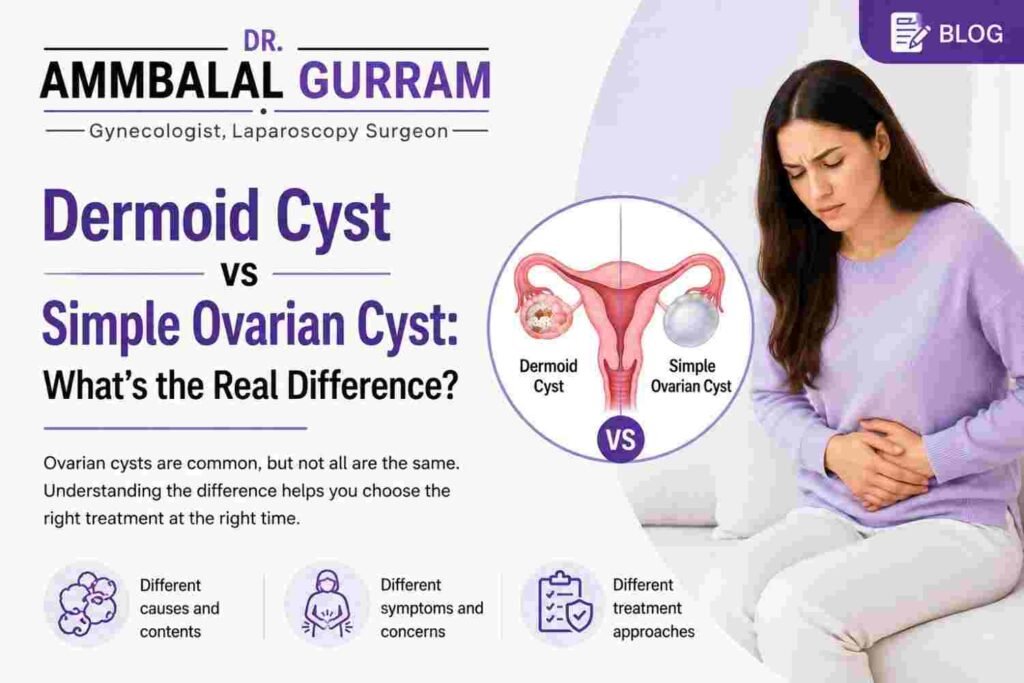
An ovarian cyst diagnosis can naturally raise questions, especially when you hear terms such as dermoid cyst or simple ovarian cyst. Although both develop in or around the ovary, they are not the same and may require different approaches to monitoring and treatment.
Understanding Dermoid Cyst vs Simple Ovarian Cyst can help you know what your ultrasound report may mean and when you should seek specialist advice. A simple ovarian cyst is often related to the normal menstrual cycle and may disappear on its own, while a dermoid cyst contains different types of tissue and generally persists.
If you have been diagnosed with an ovarian cyst, consultation with an experienced Gynecologist and Laparoscopy Surgeon, Dr. Ammbalal Gurram, can help determine the type of cyst, understand your treatment options, and decide whether monitoring or laparoscopic treatment may be appropriate.
What Is an Ovarian Cyst?
An ovarian cyst is a fluid-filled or tissue-containing sac that develops in or on an ovary. Ovarian cysts can occur at different stages of life, although they are particularly common during the reproductive years. Some cysts develop as part of the normal menstrual cycle, while others arise from different types of ovarian tissue.
The two types discussed here—simple ovarian cysts and dermoid cysts—are quite different.
What Is a Simple Ovarian Cyst?
A simple ovarian cyst is usually a fluid-filled sac with a thin, smooth wall. In women who are still having periods, many simple cysts are related to normal ovulation. For example, a follicle that does not release an egg or continues to grow after ovulation can sometimes form a functional cyst.
Common characteristics of a simple ovarian cyst
- Usually contains clear fluid
- Often has a thin and smooth wall
- Frequently develops during the reproductive years
- Many are related to the menstrual cycle
- May disappear on their own
- Often causes no symptoms
Small simple cysts are commonly discovered incidentally during an ultrasound examination.
What Is a Dermoid Cyst?
A dermoid cyst, also called a mature cystic teratoma, is a type of ovarian tumor that develops from germ cells. Unlike a simple cyst, it can contain different types of mature tissue.
A dermoid cyst may contain tissues such as fat, hair, or other tissue components. This is why its appearance on an ultrasound or other imaging examination can be different from that of a simple fluid-filled cyst.
Dermoid cysts are generally benign, but they can sometimes become large or cause complications.
Dermoid Cyst vs Simple Ovarian Cyst: Key Differences
| Feature | Simple Ovarian Cyst | Dermoid Cyst |
|---|---|---|
| Contents | Usually clear fluid | May contain fat, hair and other tissues |
| Common cause | Often related to ovulation | Develops from germ cells |
| Nature | Frequently functional | Usually benign ovarian tumor |
| Appearance on ultrasound | Usually simple, fluid-filled | May have mixed or complex appearance |
| Can disappear naturally? | Many do | Usually does not disappear on its own |
| Symptoms | Often none | May cause pain, pressure or bloating if large |
| Treatment | Often observation | Monitoring or surgery depending on size and symptoms |
| Follow-up | Ultrasound may be recommended | Imaging and specialist assessment may be needed |
Symptoms of a Simple Ovarian Cyst
Many simple ovarian cysts do not cause noticeable symptoms. When symptoms occur, they may include:
- Lower abdominal or pelvic discomfort
- A feeling of fullness or pressure
- Bloating
- Pain during intercourse
- Changes in menstrual symptoms
- Occasional pelvic pain
Sudden severe pain may indicate a complication and should be medically evaluated promptly.
Symptoms of a Dermoid Cyst
Small dermoid cysts may also remain completely asymptomatic. As the cyst becomes larger, however, symptoms can develop.
Possible symptoms include:
- Pelvic or lower abdominal pain
- Abdominal pressure or fullness
- Bloating
- Discomfort during certain activities
- Pain during intercourse
- Increased abdominal size in larger cysts
In some cases, a dermoid cyst can cause ovarian torsion, where the ovary twists around its supporting tissues. This can result in sudden and severe pelvic pain and requires urgent medical attention.
How Are These Cysts Diagnosed?
The first step is generally a detailed medical consultation and pelvic imaging, particularly an ultrasound.
During evaluation, the doctor may consider:
- Your age
- Menstrual history
- Symptoms
- Pregnancy status
- Cyst size
- Cyst appearance
- Whether the cyst is changing over time
- Whether there are solid or fatty components
- Other findings on the ultrasound
A simple cyst generally has a characteristic fluid-filled appearance, while a dermoid cyst can have features suggesting the presence of fat or other tissue. Depending on the findings, your doctor may recommend repeat ultrasound examinations or additional investigations.
Does Every Ovarian Cyst Need Treatment?
No. Treatment depends on the type of cyst and the individual patient’s circumstances. For many small, simple ovarian cysts, particularly functional cysts in premenopausal women, the doctor may recommend observation and follow-up ultrasound rather than immediate surgery. Dermoid cysts are different because they generally do not resolve spontaneously. However, not every dermoid cyst automatically requires surgery.
The decision may depend on:
- Cyst size
- Symptoms
- Growth over time
- Imaging characteristics
- Age and reproductive plans
- Risk of complications
- Overall health
Treatment Options for Simple Ovarian Cysts
Depending on the circumstances, management may include:
1. Observation
If a simple cyst is small and does not cause significant symptoms, your doctor may recommend monitoring it. A follow-up ultrasound can help determine whether the cyst has disappeared, remained stable, or changed.
2. Medication
Medication may sometimes be used to manage symptoms or address the underlying menstrual or hormonal situation. However, medication does not necessarily make every existing ovarian cyst disappear.
3. Surgery
Surgery may be considered if a cyst is persistent, large, symptomatic, or has features that require further evaluation.
Treatment Options for Dermoid Cysts
Dermoid cysts usually remain present rather than disappearing naturally. When treatment is necessary, surgery may be recommended. In suitable cases, laparoscopic ovarian cystectomy may be performed to remove the cyst while preserving healthy ovarian tissue whenever possible. The exact surgical approach depends on the cyst’s size, location, appearance, symptoms, and the patient’s individual circumstances.
Can an Ovarian Cyst Affect Fertility?
The effect on fertility depends on the type of cyst and the treatment required. Many simple ovarian cysts do not have a significant long-term effect on fertility. With dermoid cysts, the cyst itself may not necessarily prevent pregnancy. However, larger cysts or surgery involving the ovary require careful evaluation to protect ovarian tissue. Women who are planning pregnancy should discuss their reproductive goals with their doctor before deciding on treatment.
When Should You Consult a Doctor?
You should consider medical evaluation if you have:
- Persistent pelvic or lower abdominal pain
- Repeated bloating or abdominal pressure
- Pain during intercourse
- An ovarian cyst that persists on follow-up scans
- A large ovarian cyst
- A cyst with complex features on ultrasound
- Sudden or severe pelvic pain
- Dizziness, weakness, or fainting associated with severe abdominal pain
Sudden severe pelvic pain, especially when accompanied by vomiting, requires prompt medical assessment because ovarian torsion or cyst rupture may need urgent treatment.
Why Specialist Consultation Matters
An ovarian cyst should not be judged by size alone. Two women with cysts of a similar size may require completely different management depending on the cyst’s appearance, symptoms, age, and reproductive plans.
A specialist consultation can help determine:
- What type of cyst you have
- Whether observation is appropriate
- Whether additional imaging is required
- Whether surgery may be beneficial
- How treatment could affect fertility
- What follow-up is needed
For women looking for professional guidance regarding ovarian cyst diagnosis and treatment, Dr. Ammbalal Gurram provides consultation to help patients understand their condition and available treatment options.
Frequently Asked Questions
1. Is a dermoid cyst more serious than a simple ovarian cyst?
Not necessarily. Most dermoid cysts are benign, while many simple ovarian cysts are functional and resolve naturally. However, dermoid cysts generally do not disappear on their own and may require monitoring or surgery depending on their characteristics.
2. Can a simple ovarian cyst disappear on its own?
Yes. Many functional simple ovarian cysts can resolve naturally over time, particularly in women who are still menstruating. Follow-up may be recommended depending on the cyst’s size and appearance.
3. Do dermoid cysts need to be removed?
Not always. The decision depends on factors such as cyst size, symptoms, growth, imaging findings, and the risk of complications.
4. Can a dermoid cyst become cancerous?
Most ovarian dermoid cysts are benign. Malignant transformation is uncommon, but your doctor will consider your age, symptoms, imaging findings, and other risk factors when determining the appropriate management.
5. Can ovarian cysts cause infertility?
Some ovarian cysts may be associated with fertility problems, but many do not affect fertility. The underlying condition, type of cyst, and treatment approach are important factors.
6. Is laparoscopic surgery possible for ovarian cysts?
In selected patients, laparoscopic surgery may be an option. Your doctor will determine whether minimally invasive surgery is appropriate based on the cyst and your overall health.
Consult Dr. Ammbalal Gurram for Ovarian Cyst Evaluation and Treatment
If you have been diagnosed with a dermoid cyst, simple ovarian cyst, or another ovarian cyst, getting the right medical evaluation is important before deciding on treatment. The management of an ovarian cyst depends on factors such as its type, size, appearance on ultrasound, symptoms, age, and reproductive plans.
Dr. Ammbalal Gurram, Gynecologist & Laparoscopic Surgeon, is a senior consultant in Gynaecology and Laparoscopic Surgery. He provides evaluation and treatment for ovarian cysts and offers laparoscopic ovarian cyst removal when surgery is clinically appropriate.
Dr. Ammbalal Gurram has qualifications including MBBS, DGO, DNB, MNAMS, FMAS, FICMCH, FICOG, FIAGE and FICS (USA) and is listed with 22 years of experience on his official doctor profile.
Consultation for Ovarian Cysts
If you are experiencing persistent pelvic pain, abdominal discomfort, bloating, or have an ovarian cyst detected during an ultrasound, consult a qualified gynecologist for personalized evaluation.
Dr. Ammbalal Gurram – Gynaecology & Laparoscopy Surgeon
Consultation locations:
- Ashwinii Nursing Home, Office 1,2, Samarth Carina, 3 &4, Commercia, near Raghavendra Swami Math, Thergaon, Pimpri-Chinchwad, Maharashtra 411033
- Manipal Hospital, baner – best gynecologist in baner : Dr Ammbalal Gurram, Manipal Hospitals Baner, Survey No 111/11/1 Veerbhadra Nagar Rd, Baner – Mahalunge Rd, Baner, Pune, Maharashtra 411069
Contact: +91-8600711131
For consultation and more information, visit the official website: Dr. Ammbalal Gurram – Gynaecology & Laparoscopy Surgeon in pune
Do not ignore persistent or severe pelvic pain. Early evaluation can help determine whether an ovarian cyst needs observation, follow-up imaging, or treatment.