
Bleeding After Menopause
For most women, menopause means the end of monthly periods. So when bleeding after menopause appears months or even years later, it can be confusing and worrying. Many women ignore a little spotting after menopause, hoping it will settle on its own.
The most important thing to know is this: post menopausal bleeding is never considered normal, and it should always be checked by a doctor. In most women the cause is harmless and easy to treat. In some, however, postmenopausal bleeding is the earliest sign of a serious condition, including cancer of the uterus. Timely evaluation gives clear answers and the best possible outcome.
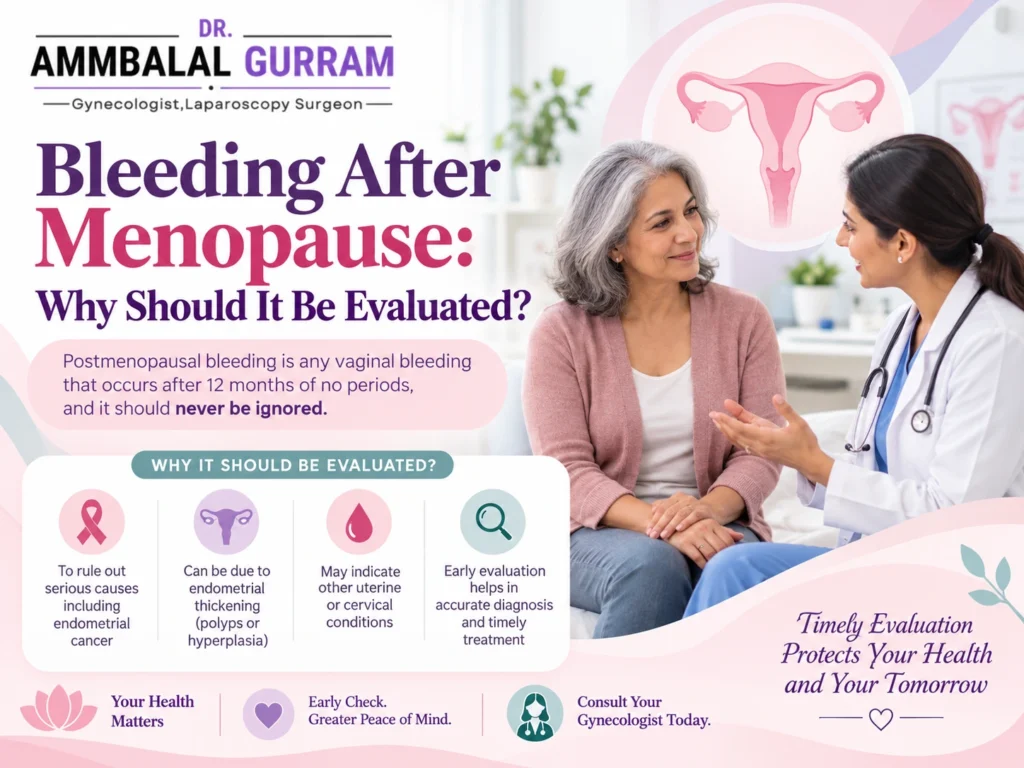
What Is Postmenopausal Bleeding?
Menopause is confirmed when a woman has had no period for 12 consecutive months. Postmenopausal bleeding is any vaginal Post menopausal bleeding, once this point has passed. Postmenopausal Bleeding in women can show up in different ways, and the common menopause bleeding symptoms include:
- Spotting blood postmenopausal, such as pink, red or brown discharge on underwear or tissue
- A small amount of postmenopausal bleeding, even if it happens only once
- Bleeding from the vagina after menopause that looks like a light period
- Heavy vaginal bleeding with or without clots
- Bleeding after intercourse, sometimes with pain or discharge
The amount of blood does not decide how serious the problem is. A few drops deserve the same attention as heavier bleeding.
Is Bleeding After Menopause Normal?
No. Postmenopausal Bleeding is not normal, and any abnormal Postmenopausal bleeding should be looked into, whether it is light or heavy, one-time or repeated. Women who take hormone replacement therapy (HRT) may have some expected bleeding depending on the type of regimen, but even then, unexpected or continuing bleeding needs to be reviewed.
Many women also ask, “is spotting after menopause dangerous?” Most of the time the cause is benign, but the spotting itself cannot tell you that. Harmless thinning of the vaginal lining and an early uterine cancer can look exactly the same from the outside: a little blood and no pain. That is why a check-up is the only safe way to know.
Why Does Bleeding Occur After Menopause?
There are several reasons why bleeding occurs after menopause. Knowing the common causes of bleeding after menopause helps explain why the cause can only be found through examination and tests. Here is what causes vaginal post menopausal bleeding.
1. Vaginal and endometrial atrophy
After menopause, estrogen levels fall sharply. The lining of the vagina and the uterus becomes thin, dry and fragile, and bleeds easily. This is the most common of all postmenopausal bleeding causes. It is harmless, but it should still be confirmed by a doctor.
2. Endometrial and cervical polyps
Polyps are soft growths on the lining of the uterus or the cervix. They are usually non-cancerous, but they can cause spotting or bleeding and often need to be removed and tested.
3. Endometrial hyperplasia
This is a thickening of the uterine lining caused by excess estrogen without enough progesterone. Some forms are mild, while others can turn into cancer if left untreated.
4. Hormone replacement therapy
Hormone therapy, especially some combined regimens, can cause bleeding. Persistent or unexpected bleeding while on HRT may need a change in the dose or type of treatment.
5. Fibroids
Fibroids usually shrink after menopause, but some can still cause vaginal bleeding after menopause, particularly in women on hormone therapy.
6. Infections and inflammation
Infections of the cervix, vagina or uterus can irritate the tissue and cause spotting.
7. Medicines
Blood thinners and tamoxifen, a drug used in breast cancer treatment, can contribute to bleeding. Tamoxifen can also thicken the uterine lining, so any bleeding while taking it needs prompt attention.
8. Uterine, cervical and other cancers
Cancer of the uterine lining (endometrial cancer) is the most serious cause. Cervical, vaginal and vulvar cancers can also cause postmenopausal bleeding.
Can Bleeding After Menopause Indicate Uterine Cancer?
Yes, it can. Roughly one in ten women with postmenopausal bleeding is found to have endometrial (uterine) cancer, and bleeding is often the first and sometimes the only symptom. The good news is that when uterine cancer is found early, because the woman reported her bleeding, it is often highly curable, frequently with surgery alone.
So when to worry about postmenopausal bleeding? The honest answer is that you should act on any bleeding, however small. The following make a prompt visit even more important:
- Bleeding that is heavy, repeated or increasing
- Pelvic pain or pressure, or a foul-smelling or watery discharge
- Unexplained weight loss, fever or dizziness
- Risk factors such as obesity, diabetes, high blood pressure, PCOS or irregular periods earlier in life, late menopause, never having been pregnant, tamoxifen use, or a family history of uterine, ovarian or colon cancer
Why Should Bleeding After Menopause Be Evaluated?
Should post menopausal bleeding be evaluated even if it happened only once or stopped on its own? Yes, and here is why:
- It may be an early warning sign. Finding a problem at an early stage makes treatment simpler and results better.
- The cause cannot be guessed. Only a proper postmenopausal bleeding evaluation can tell harmless causes from serious ones.
- Precancerous changes can be treated. Conditions such as hyperplasia can be managed with medicines or minor procedures before they turn into cancer.
- It brings peace of mind. In most women the evaluation ends with a simple, reassuring answer and an easy treatment.
Stopping the bleeding does not mean the cause has gone away. Waiting and watching is the one approach that is not recommended.
Treatment Options for Postmenopausal Bleeding
Postmenopausal bleeding treatment depends entirely on what is causing it. The treatment options for postmenopausal bleeding include:
- Atrophy: Vaginal estrogen creams, moisturisers and lubricants to restore the thin, dry tissue.
- Polyps: Removal through hysteroscopy, followed by testing of the tissue.
- Endometrial hyperplasia: Hormonal treatment such as progestins with close follow-up, or surgery in selected cases.
- HRT-related bleeding: Reviewing and adjusting the type, dose or schedule of hormone therapy.
- Infections: Appropriate medicines after identifying the cause.
- Uterine cancer: Usually surgery to remove the uterus, often by minimally invasive laparoscopic methods, with additional treatment if needed.
When to See a Gynecologist for Bleeding After Menopause
If you are wondering when to see a gynecologist for spotting after menopause, the answer is as soon as you notice it. Do not wait for it to happen again. Book a consultation if you have any spotting or vaginal postmenopausal bleeding, and seek urgent care if the bleeding is heavy or comes with pelvic pain, dizziness, fever or foul-smelling discharge.
Diagnosis of Postmenopausal Bleeding: Tests for Bleeding After Menopause
Women often worry that evaluating postmenopausal bleeding may be complicated. In reality, the diagnosis is often straightforward, and many tests for postmenopausal bleeding can be performed in a clinic. Depending on your medical history and symptoms, your gynecologist may recommend specific tests to identify the cause and guide further care. If you are considering gynecology treatments in Pune, consulting a gynecologist can help you understand the available evaluation and treatment options.
- Medical history and pelvic examination: Questions about when the bleeding began, how much there was, any HRT or other medicines, followed by a speculum and pelvic examination.
- Transvaginal ultrasound: A painless scan that measures the thickness of the uterine lining and checks the uterus and ovaries. A thin lining is reassuring, while a thicker lining needs further testing.
- Endometrial biopsy: A small sample of the uterine lining is taken in the clinic and examined under a microscope to look for hyperplasia or cancer.
- Hysteroscopy: A thin camera is passed through the cervix to look directly inside the uterus. Polyps or suspicious areas can be seen, removed and tested, often in the same sitting.
- Pap smear and other tests: To check the cervix, along with blood tests or further imaging if required.
Postmenopausal Bleeding Treatment in Pune: Consult a Gynecologist
If you or someone in your family has noticed post menopausal bleeding, finding the right gynecologist in Pune is the first step. Dr. Ammbalal Gurram, Gynaec Laparoscopic Surgeon in Baner, Pune, offers complete evaluation and gynecology treatments in Pune for postmenopausal bleeding, including ultrasound assessment, biopsy, hysteroscopic procedures and advanced laparoscopic surgery when needed.
As a gynecologist for menopause problems in Pune, he can help you understand the cause of your symptoms, guide you through the tests, and suggest the most suitable postmenopausal bleeding treatment in Pune for your situation. Early evaluation gives you clear answers and peace of mind.
Clinic address: [Manipal Hospitals Baner, Survey No 111/11/1 Veerbhadra Nagar Rd, Baner – Mahalunge Rd, Baner, Pune, Maharashtra 411069 ]
Phone / WhatsApp: [+918600711131 ]
Clinic address: [Office 1,2, Samarth Carina, 3 &4, Commercia, near Raghavendra Swami Math, Thergaon, Pimpri-Chinchwad, Maharashtra 411033 ]
Phone / WhatsApp: [+9108408919177 ]
Frequently Asked Questions
What is postmenopausal bleeding?
It is any vaginal bleeding that occurs after a woman has gone 12 months without a period. It includes spotting, light bleeding and heavy bleeding.
Is bleeding after menopause normal?
No. spotting after menopause is never considered normal and should always be evaluated by a gynecologist, even if it is only a small amount.
What are the common causes of bleeding after menopause?
The most common cause is thinning of the vaginal and uterine lining due to low estrogen. Other causes include polyps, endometrial hyperplasia, fibroids, infections, hormone therapy, certain medicines, and cancers of the uterus or cervix.
Can bleeding after menopause indicate uterine cancer?
Yes. Bleeding is the most common early symptom of uterine cancer, although most women with postmenopausal bleeding turn out to have a non-cancerous cause. Only testing can tell the difference.
What tests are needed for postmenopausal bleeding?
Usually a pelvic examination and a transvaginal ultrasound, followed if needed by an endometrial biopsy or hysteroscopy. A Pap smear and other tests may also be advised.
When should you consult a gynecologist for bleeding after menopause?
As soon as you notice any bleeding or spotting, even if it is light, happens once, or has stopped.
Where can I get gynecology treatments in Pune for postmenopausal bleeding?
You can consult Dr. Ammbalal Gurram, Gynaec Laparoscopic Surgeon in Baner, Pune, for evaluation and gynecology treatments in Pune, including tests, hysteroscopic procedures and laparoscopic surgery when required.