Hysteropexy Surgery
Hysteropexy Surgery in Pune
Hysteropexy is a surgical procedure to lift and fix the uterus back into its correct position when it has dropped due to prolapse — without removing it. The uterus is supported using either the patient’s own ligaments or a surgical mesh, and secured so it cannot descend again. It is the uterus-preserving alternative to hysterectomy for treating uterine prolapse.
Dr. Ammbalal Gurram performs hysteropexy surgery in Pune at Manipal Hospital Baner and Ashwinii Nursing Home Thergaon (PCMC). MBBS, DGO, DNB. Fellowship in advanced laparoscopic surgery. 26 years experience. 98% surgical success rate.
Over-the-Counter (OTC) Medication Guidance
Other Service
Take the First Step to Better Health Today
What Is Uterine Prolapse? Understanding the Problem First
The uterus sits in the pelvis held up by a network of muscles, ligaments, and connective tissue — collectively called the pelvic floor. When these supports weaken or tear, the uterus loses its anchoring and begins to descend into the vaginal canal. This is uterine prolapse.
It is more common than most women realise. The pelvic floor takes the most damage during vaginal childbirth, especially after multiple deliveries or large babies. Menopause accelerates the process as falling oestrogen levels cause the connective tissue to thin and lose elasticity. Women in Pune, Baner, Thergaon, Pimpri-Chinchwad and across PCMC present to Dr. Gurram’s clinic at various stages — some with early symptoms, many having quietly managed the condition for years before seeking help.
| Grade | What Is Happening | Typical Symptoms |
|---|---|---|
| Grade 1 (Mild) | Uterus descends into the upper vagina | Pelvic heaviness, backache, feeling of something inside |
| Grade 2 (Moderate) | Uterus reaches the vaginal opening | Visible or palpable bulge; worsens after standing or lifting |
| Grade 3 (Severe) | Uterus protrudes outside the vaginal opening | Constant discomfort; difficulty walking; skin irritation |
| Grade 4 (Complete) | Full uterus outside the body (procidentia) | Significant impact on daily life; urinary and bowel problems |
Common Symptoms Women in Pune Report Before Coming to Dr. Gurram
- Feeling of pressure or heaviness in the lower abdomen or pelvis — gets worse by evening
- A visible or palpable bulge at or outside the vaginal opening
- Lower back pain that worsens after standing for long periods
- Leaking urine when coughing, sneezing, or lifting (stress incontinence)
- Difficulty emptying the bladder completely
- Discomfort or reduced sensation during sex
- Having to push the bulge back in manually to pass urine or open bowels
What We Offers
Personalized Healthcare Solutions for Every Stage of Life
Expert gynecological care focused on your comfort, health, and confidence. We offer comprehensive women’s healthcare, including routine exams, pregnancy care, and treatment for a wide range of conditions.
What Is Hysteropexy — and How Is It Different from Hysterectomy?
For years, the standard surgical treatment for significant uterine prolapse in India was hysterectomy — removing the uterus. The logic was that a uterus causing problems could simply be removed. Many women, however, do not want that. They want the problem fixed without losing the organ.
Hysteropexy does exactly that. Rather than removing the uterus, the surgeon lifts it and fixes it firmly to a stable structure — either the sacral bone at the back of the pelvis (sacrohysteropexy) or the uterosacral ligaments (uterosacral hysteropexy). The uterus stays. The prolapse is corrected. Symptoms resolve.
| Hysteropexy | Hysterectomy for Prolapse | |
|---|---|---|
| Uterus | Preserved and repositioned | Removed permanently |
| Fertility | Maintained (if applicable) | Lost permanently |
| Hormonal function | Unchanged | Unchanged (ovaries kept) |
| Surgical complexity | Moderate to high | Moderate |
| Prolapse correction | Excellent | Excellent |
| Risk of vault prolapse later | Lower (uterus provides anchor point) | Higher (vault can still prolapse) |
| Recovery | 2–4 weeks (laparoscopic) | 2–3 weeks (vaginal/lap) |
| Right for women who | Want to keep their uterus; younger patients; fertility concerns | Family complete; no preference for preservation |
Types of Hysteropexy — Which One Is Right for You?
There are several surgical techniques. Dr. Gurram selects the approach based on the grade of prolapse, your anatomy, age, fertility wishes, and whether other pelvic floor repairs are needed at the same time.
Laparoscopic Sacrohysteropexy
The uterus is lifted and fixed to the sacral promontory (the front surface of the sacrum — the bone at the base of the spine) using a surgical mesh. This gives a very durable, anatomically correct suspension. It is the preferred approach for significant prolapse, especially in younger women who want long-term results. Performed entirely through keyhole incisions.
Laparoscopic Uterosacral Ligament Suspension
The uterus is re-attached to the uterosacral ligaments, which are the natural support structures that weakened or elongated. This mesh-free approach uses the patient’s own tissue. Good results in mild to moderate prolapse. Preferred where mesh use is a concern.
Manchester Repair (Vaginal Approach)
A vaginal procedure that shortens the cervix and tightens the cardinal ligaments. Suitable for older patients with moderate prolapse who prefer a vaginal approach. No laparoscopic ports needed. Recovery is similar to vaginal hysterectomy.
Combined Pelvic Floor Repair
Prolapse rarely occurs in isolation. Many patients also have a cystocoele (bladder bulge) or rectocoele (bowel bulge) alongside the uterine descent. Dr. Gurram routinely addresses all components in the same surgery so you are not returning for a second procedure six months later.
Make An appoinment
Schedule your appointment quickly and easily. Choose a date and time that fits your schedule, and our team will be ready to assist you with personalized care and attention.
Consultation
Get expert guidance tailored to your needs. Schedule a consultation with our experienced professionals to discuss your concerns and receive personalized recommendations.
Begin Your Treatment
Start your journey toward better health with a personalized treatment plan tailored to your needs. Our experienced team is committed to providing compassionate care every step of the way.
The Surgery — What to Expect
Before Surgery
At consultation, Dr. Gurram does a full pelvic assessment — examining which compartments are prolapsed, grading the descent, and evaluating bladder and bowel function. A pelvic ultrasound is usually done. Urodynamic studies (bladder pressure testing) may be requested if there is significant urinary leakage. Blood tests and anaesthetic fitness are checked beforehand.
For women in Baner, Thergaon, Wakad, Pimpri, Chinchwad and nearby areas of PCMC, both clinic locations are well equipped for this pre-operative workup.
During Surgery (Laparoscopic Approach)
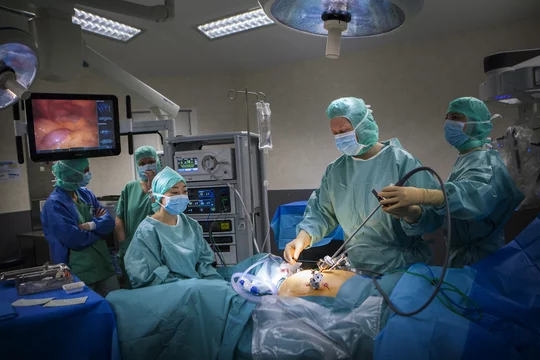
General anaesthesia. Three to four small cuts under 1 cm each. The laparoscope gives a magnified view of the pelvic floor structures — better visibility than open surgery in many respects. Dr. Gurram identifies the prolapsed uterus, dissects the relevant ligaments or prepares the sacral attachment point, secures the uterus using the chosen technique, and closes.
If a simultaneous anterior or posterior repair is needed for bladder or bowel prolapse, this is done in the same sitting. Operating time: 60 to 120 minutes depending on complexity.
After Surgery
Most patients go home the next day. A urinary catheter is usually in for just 24 hours — much shorter than radical surgery. Mild pelvic soreness for the first week is expected. Most women from Baner, Thergaon, and PCMC who have this surgery with Dr. Gurram are back to light daily activity within 10 to 14 days and fully recovered by week 4 to 6.
Recovery After Hysteropexy in Pune
| Time After Surgery | How You Feel | What You Can Do |
|---|---|---|
| Day 1 (Hospital) | Mild pelvic discomfort; catheter in for 24 hrs; mobile by evening | Ward walking; light fluids |
| Day 2 (Discharge) | Comfortable; mild soreness at port sites | Slow walking at home; stairs fine |
| Week 1 | Fatigue; pelvic tenderness; pain tablets as needed | Light indoor activity; no lifting over 2 kg |
| Week 2 | Soreness settling; most off pain tablets | Short walks outside; light housework |
| Week 3–4 | Near-normal energy | Desk work return; no strenuous activity |
| Week 5–6 | Full recovery; follow-up with Dr. Gurram | All activities cleared; pelvic floor exercises ongoing |
| 3 Months | Pelvic floor strengthening well established | Unrestricted activity |
After Surgery
- No heavy lifting (more than 2–3 kg) for 6 weeks — this is the most important recovery rule
- Pelvic floor exercises (Kegel exercises) are started from Week 2 and continued long-term
- No sexual intercourse for 6 weeks
- Avoid prolonged standing and straining at stool
- Constipation is the enemy of pelvic floor recovery — increase fibre and fluids from Day 1
Who Is a Good Candidate for Hysteropexy in Pune?
- Women with uterine prolapse Grade 2 or above — especially where symptoms are affecting daily life
- Women who want to keep their uterus — whether for fertility, personal preference, or both
- Younger women where hysterectmy would be premature
- Women with mild to moderate prolapse where pelvic floor exercises alone have not helped
- Women who have completed their family but still want uterine preservation
- Women with simultaneous bladder or bowel prolapse (Dr. Gurram repairs all in one sitting)
Why Dr. Ammbalal Gurram for Hysteropexy in Pune
- 26 years in pelvic floor surgery and laparoscopic gynaecology in Pune
- 2,000+ surgeries | 98% surgical success rate | 5,000+ patients treated
- Director, Centre for Advanced Gynaecology Laparoscopy — Ashwinii Nursing Home Thergaon
- Consultant, Manipal Hospital Baner — full OT, ICU and urogynecology support
- Performs hysteropexy, sacrohysteropexy, and combined pelvic floor repair routinely — not occasionally
- Addresses all prolapse compartments (anterior, posterior, apical) in a single surgery where needed
- Does not default to hysterectomy when prolapse repair is the right option
- Women from Baner, Thergaon, Pimpri, Chinchwad, Wakad, Hinjewadi, Ravet, Nigdi and all of PCMC attend his two clinics
Frequently Asked Questions
Will prolapse come back after hysteropexy?
Recurrence is possible but uncommon with a well-performed repair. Laparoscopic sacrohysteropexy — where the uterus is anchored to the sacrum — has among the best long-term durability rates in prolapse surgery. Maintaining a healthy weight, avoiding chronic constipation, and doing pelvic floor exercises lifelong all reduce recurrence risk. Dr. Gurram discusses the realistic long-term picture at consultation.
Is mesh used in hysteropexy? Is it safe?
In laparoscopic sacrohysteropexy, a small piece of surgical mesh is used to create the suspension. The mesh used in this approach (placed internally, not vaginally) has a much better safety record than the vaginal mesh procedures that were withdrawn from some markets. Dr. Gurram uses only appropriately approved mesh materials and explains the mesh vs mesh-free options based on your specific case and preferences.
Can hysteropexy be done at the same time as other repairs?
Yes — and this is often the better approach. Women with uterine prolapse frequently also have a cystocoele (anterior wall prolapse causing bladder symptoms) or rectocoele (posterior wall prolapse causing bowel symptoms). Dr. Gurram repairs all components in a single laparoscopic procedure rather than staging them as separate operations.
I am 55 and post-menopausal. Is hysteropexy still an option for me?
Age is not a barrier to hysteropexy. Post-menopausal women get very good results. The main consideration is fitness for general anaesthesia, which is assessed pre-operatively. If fertility is not a factor but the patient strongly prefers to keep her uterus, hysteropexy is still a valid choice at any age.
How do I know if my symptoms are prolapse or something else?
A pelvic examination by Dr. Gurram at Baner or Thergaon will confirm the diagnosis within minutes. Common conditions that get confused with prolapse include bladder infections, large ovarian cysts, and pelvic floor muscle weakness without actual descent. A physical examination and ultrasound together clarify the picture. Booking a consultation is the most direct route to an answer.
Book an Appointment
Schedule your appointment in just a few clicks. Choose a date and time that works best for you, and our team will be ready to assist you.

Dr. Ammbalal Gurram Trusted gynecologist in pune with 26+ years of experience in advanced women’s healthcare.
Dr Ammbalal Gurram Gynecologist Laparoscopic/Robotic Surgeon in Baner | Best Gynecologist in Baner, Balewadi, PuneManipal Hospitals Baner
Dr Ammbalal Gurram-Best Gynecologist,Gynae Laparoscopic.Hysterectomy,Ovarian Cyst,Fibroid Removal Surgeon in Wakad,Ravet,PCMC
All Rights are Reserved By Dr. Ammbalal Gurram | Website Designed by EDGELINK Technology Pvt Ltd.