
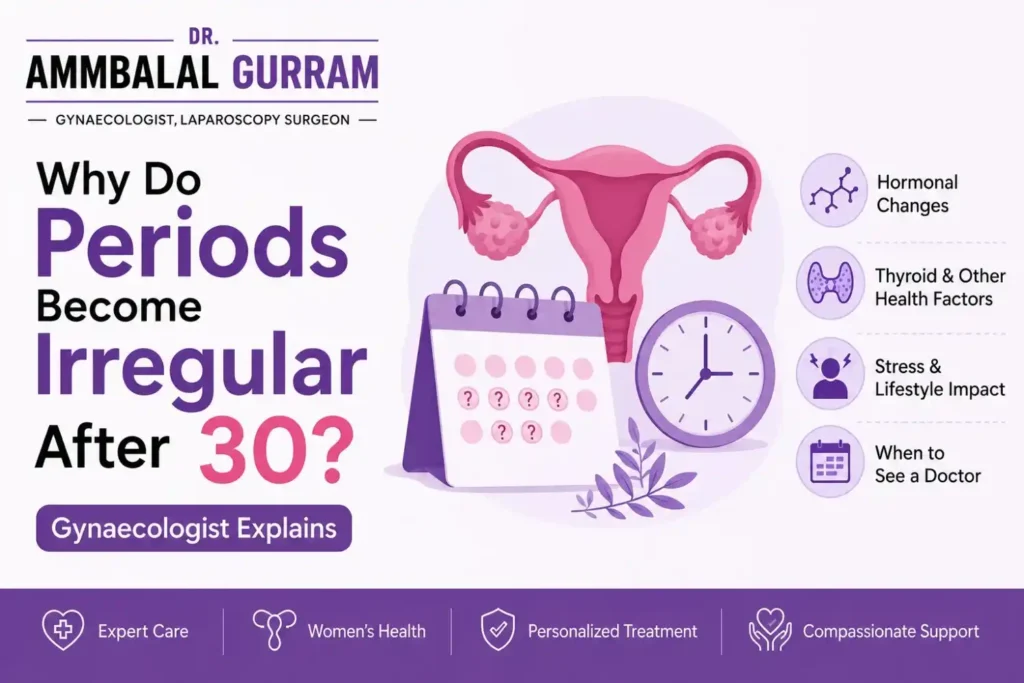
Why Do Periods Become Irregular After 30 primarily due to hormonal shifts, including declining progesterone levels, early perimenopause, thyroid dysfunction, PCOS, and increased stress. Cycle length may change, flow may become heavier or lighter, and spotting between periods can occur. While some variation is normal, persistent irregularity lasting more than three months warrants a gynaecologist evaluation.
A woman who has had regular periods for years can find them suddenly shifting after she turns 30. The cycle that was once predictable starts arriving a week early or a week late. Flow that was manageable becomes heavier. Spotting appears between periods with no obvious reason. These changes are common but they are not something to dismiss without understanding what is driving them.
The 30s are a decade of significant hormonal transition for many women. Career demands, pregnancies, stress, and the very early beginnings of hormonal change all converge in this period. Understanding why periods change at this stage helps you make better decisions about when to watch and wait and when to see a specialist.
What Counts as an Irregular Period?
A normal menstrual cycle runs between 21 and 35 days. A period lasting 2 to 7 days with a blood loss of 30 to 80 ml is considered within the normal range. Irregularity means the cycle is consistently shorter or longer than this window, or that the duration, flow, or timing varies significantly from one cycle to the next.
Occasional variation due to travel, illness, or a particularly stressful month is not cause for concern. The concern starts when irregularity becomes a pattern over three or more consecutive cycles, or when it is accompanied by symptoms like excessive pain, very heavy bleeding, or spotting after intercourse.
Why Do Periods Become Irregular After 30 : Top 10 Reasons
There is rarely a single cause. In most cases, one or more of the following factors are at work:
1. Declining progesterone levels: After 30, the body’s progesterone output begins a gradual decline. Progesterone is the hormone that stabilises the second half of the menstrual cycle and regulates how the uterine lining sheds. When levels drop, cycles can become shorter, flow can become heavier, and the luteal phase can shorten.
2. Perimenopause starting earlier than expected: Most women associate perimenopause with their mid-to-late 40s, but hormonal changes can begin as early as the mid-30s. Early perimenopause causes erratic oestrogen fluctuations that lead to unpredictable cycle lengths and changes in flow. It does not mean fertility has ended, but it does change how the cycle behaves.
3. Polycystic Ovary Syndrome (PCOS): PCOS is one of the most common causes of irregular periods across all adult age groups. It involves elevated androgen levels, insulin resistance, and disrupted ovulation. Many women go undiagnosed into their 30s because their symptoms were attributed to stress or diet. Irregular cycles, weight gain around the abdomen, and difficulty conceiving are common presentations.
4. Thyroid dysfunction: Both hypothyroidism and hyperthyroidism directly affect menstrual regularity. An underactive thyroid slows the entire hormonal cycle and can cause heavy, prolonged, or infrequent periods. An overactive thyroid can make periods lighter and less frequent. Thyroid issues are often missed because the symptoms overlap with general fatigue and stress.
5. Stress and cortisol elevation: Chronic stress raises cortisol, which suppresses the hypothalamic-pituitary-ovarian axis. The brain effectively deprioritises reproduction when it perceives the body to be under threat. This can delay ovulation, shorten the luteal phase, or stop periods altogether in severe cases. Women in high-pressure work environments or going through personal crises often notice their cycle shifting first.
6. Significant weight changes: Both weight gain and rapid weight loss affect oestrogen production. Fat cells produce oestrogen, so a major drop in body weight can reduce oestrogen enough to disrupt ovulation. Conversely, excess weight can elevate oestrogen to levels that thicken the uterine lining and cause heavy or irregular bleeding.
7. Uterine fibroids or polyps: Non-cancerous growths inside or around the uterus become more common from the mid-30s onward. Fibroids and endometrial polyps can cause heavy, prolonged, or irregular bleeding even when hormone levels are otherwise normal. They are among the most underdiagnosed causes of changed bleeding patterns in this age group.
8. Endometriosis: Tissue similar to the uterine lining grows outside the uterus in endometriosis. It causes painful and often irregular periods, heavy flow, and spotting. Many women reach their 30s with a years-long undiagnosed history of painful cycles before the condition is properly identified.
Warning Signs That Should Not Be Ignored
Not every irregular period needs immediate investigation, but certain symptoms alongside irregularity do require prompt evaluation:
1. Bleeding between periods: Spotting mid-cycle can indicate hormonal imbalance, polyps, cervical changes, or in some cases infection. It should always be assessed rather than assumed to be normal.
2. Periods lasting more than 7 days: Prolonged bleeding increases the risk of anaemia and often indicates structural causes like fibroids or hormonal imbalance that need treatment.
3. Soaking more than one pad per hour: Heavy flow of this level is not normal and can lead to iron deficiency anaemia. It requires investigation into its cause.
4. Severe cramping that was not present before: A sudden increase in period pain in a woman who previously had manageable periods may point to endometriosis, fibroids, or pelvic inflammatory disease.
5. No period for more than 90 days: Unless pregnant, the absence of periods for three months needs evaluation. It could indicate early ovarian insufficiency, extreme stress, thyroid disease, or another underlying condition.
How Irregular Periods Are Investigated
A gynaecologist will typically start with a detailed menstrual history covering cycle length, flow pattern, associated symptoms, and any recent changes in weight, stress levels, or medication. This history alone often points to the most likely cause.
Blood tests check hormone levels including FSH, LH, oestradiol, progesterone, TSH, and prolactin. A fasting insulin and blood glucose test may be ordered if PCOS is suspected. A pelvic ultrasound assesses the uterus and ovaries for structural causes like fibroids, polyps, or cystic follicles. In some cases, a hysteroscopy or endometrial biopsy may be recommended to evaluate the uterine lining directly.
The combination of history, blood tests, and imaging usually provides a clear diagnosis within one or two consultations.
Can Irregular Periods After 30 Affect Fertility?
Irregular periods are often a sign of irregular or absent ovulation, and ovulation is necessary for natural conception. Women in their 30s who are trying to conceive and have irregular cycles should seek evaluation sooner rather than later, as fertility does decline with age and addressing the underlying cause early improves outcomes.
PCOS, thyroid dysfunction, and early perimenopause are all conditions that affect fertility but are also very treatable when identified early. A fertility assessment alongside the menstrual investigation gives a complete picture for women who are planning pregnancy in their 30s.
What Can Be Done About Irregular Periods?
Treatment depends entirely on the diagnosed cause. There is no single fix for irregular periods because the causes are different for every patient.
Hormonal imbalance caused by stress or lifestyle factors often responds well to targeted changes in diet, sleep, and activity alongside short-term hormonal support if needed. PCOS is managed through insulin-sensitising strategies, dietary changes, and medication to regulate ovulation. Thyroid dysfunction is treated with thyroid hormone replacement or suppression depending on whether the gland is under or overactive.
Fibroids and polyps may be managed medically or surgically depending on their size, location, and the patient’s symptoms and fertility plans. Endometriosis management ranges from hormonal suppression to laparoscopic surgery. A gynaecologist with experience in minimally invasive surgery can often address structural causes with shorter recovery times than traditional open surgery.
The important thing to understand is that irregular periods are a symptom, not a diagnosis. Treating the symptom without finding the cause only delays proper management.
Frequently Asked Questions
Is it normal for periods to change after 30?
Some variation is normal, particularly around periods of high stress, significant weight change, or illness. What is not normal is a persistent change in cycle length, flow, or timing lasting three or more cycles. Any such change is worth discussing with a gynaecologist.
Can stress alone cause irregular periods after 30?
Yes, chronic stress can disrupt the hormonal signals that regulate ovulation and menstruation. However, stress is often one of several contributing factors. It is worth getting investigated to rule out thyroid problems or PCOS before attributing the irregularity entirely to stress.
At what age does perimenopause usually start?
Perimenopause typically begins in the mid to late 40s, but hormonal changes that affect the cycle can start from the mid-30s in some women. Early signs include shorter cycles, heavier flow, and occasional missed periods. A blood test measuring FSH levels can indicate whether early perimenopausal changes are occurring.
Should I wait and see or see a doctor immediately?
If the irregularity is new, has lasted more than three cycles, or comes with any warning signs such as very heavy flow, severe pain, or bleeding between periods, see a gynaecologist rather than waiting. Early assessment leads to faster resolution and rules out anything that needs prompt attention.
Can irregular periods settle on their own?
Stress-related irregularity often resolves once the stressor is removed. However, structural or hormonal causes do not resolve without treatment. Waiting too long to investigate can allow conditions like fibroids or endometriosis to progress and become more complex to manage.
About Dr. Ammbala Gurram
Dr. Ammbala Gurram is a DNB-qualified obstetrician and gynaecologist with over 26 years of clinical experience, 2,000+ surgeries performed, and a 98 percent surgical success rate. He completed his MBBS from Shivaji University in 1998, his DGO from the College of Physicians and Surgeons Mumbai in 2003, and his DNB in Obstetrics and Gynaecology from the National Board of Examination in 2006.
He went on to complete a Fellowship in Advanced Gynaec Laparoscopic Surgery and received advanced laparoscopic and robotic surgical training under Dr. Shailesh Puntambekar at Galaxy Care Hospital, one of India’s most respected centres for minimally invasive gynaecological surgery.
Dr. Gurram holds active memberships in the Indian Medical Association (IMA) PCB Branch, the Pune Obstetrics and Gynaecology Society (POGS), the Federation of Gynaec and Obstetric Societies of India (FOGSI), the Indian Association of Gynaecological Endoscopists (IAGE), the Indian College of Maternal Child Health (ICMCH), the National Academy of Medical Sciences (NAMS), and is a Fellow of the Robotic Surgeons of India.
He practices at his nursing home in Thergaon and has built a reputation among colleagues for taking on complex laparoscopic and robotic cases involving challenging uterine anatomy, prior abdominal surgeries, and patients seeking scarless surgical outcomes.
Consult Dr. Ammbala Gurram for Irregular Periods in Pune and PCMC
If you have noticed a change in your menstrual cycle and are based in Pune or PCMC, including the areas of Baner, Thergaon, or the wider Pimpri Chinchwad region, you do not need to wait and wonder. A single consultation with an experienced gynaecologist can identify the cause and give you a clear path forward.
Dr. Ammbala Gurram sees patients at his nursing home in Thergaon and brings over 26 years of experience in diagnosing and treating menstrual irregularity, PCOS, fibroids, endometriosis, and all aspects of women’s health. Women travelling from Baner, Balewadi, Wakad, and surrounding PCMC localities regularly visit his clinic for specialist care close to home.
Book Your Appointment with Dr. Ammbala Gurram
Call or WhatsApp: 086007 11131
Clinic: Ammbala Gurram Nursing Home, Thergaon, PCMC, Pune
Serving patients from Baner, Thergaon, Wakad, Balewadi, Pimpri Chinchwad and all of Pune.